Tom Rielly, TED’s director of sponsorship and standup comic, planned not to offer a satirical summary of this year’s conference. He bows to popular demand and takes the stage as “Tom Rielly unplugged.” He tells us his preparation included, “72 miutes, 25 index cards, and one pencil made of psycoactive mycelium.” He tells Queen Noor that, “it’s hard to share the audience with another world famous queen.” And he tells us to look for his new autobiography, “The Billion Bottoms.” We would have missed him had he not taken the stage.
Psychologist Jonathan Haidt has been listening closely to the TED conference. He’s figured out that this is a pretty liberal group. And he asks the group to try a thought experiment – two Americans are in Italy looking at the famous statue of David. One is amazed by the beauty of the form; the other is embarrased by the naked penis. Which one is more likely to have voted for Bush?
Our prejudice is right, as it turns out. Liberals are much more likely to be open to new experiences. Conservatives are more likely to seek familiarity and comfort. “With that knowledge, you can understand why people eat at Applebee’s, just not anyone you know.”
He asks for a show of hands and discovers almost everyone here identifies as liberal, with a dozen libertarians and a handful of conservatives. “Our lack of diversity here is a problem.” In these homogenous groups, you end up with team mentality, and you end up rooting against the other side. “If you think half of America votes badly because they are stupid or religious, you are trapped in a matrix.” He invites us to “take the red pill, learn some moral psychology and step outside the moral matrix.”
Haidt argues that the brain is well organized at birth with certain moral values, held in place by neural and hormonal programming. He identifies five basic values:
– Care and harm avoidance. He argues that roughly 70% of the arguments made TED invoke these arguments.
– Reciprocity – we should be fair and just. 30% of arguments followed thiese arguments, he argues.
– Ingroup loyalty, our allegiance to our tribe. “When we don’t have tribes, we make them, because it’s fun” – think sports teams.
– Purity/sanctity – The right does it with sex, but he reminds us that the left does it with food
– Authority and respect
So, if everyone has these five basic moral drives, what happens when you raise people in different environments?

Haidt has been running an experiment at YourMorals.org. It asks people their political affiliations and their moral beliefs. It turns out that liberals care more than conservatives about harm and fairness. And liberals care a lot less about authority, ingroup and purity. This is true in all the nations where they’ve collected data.
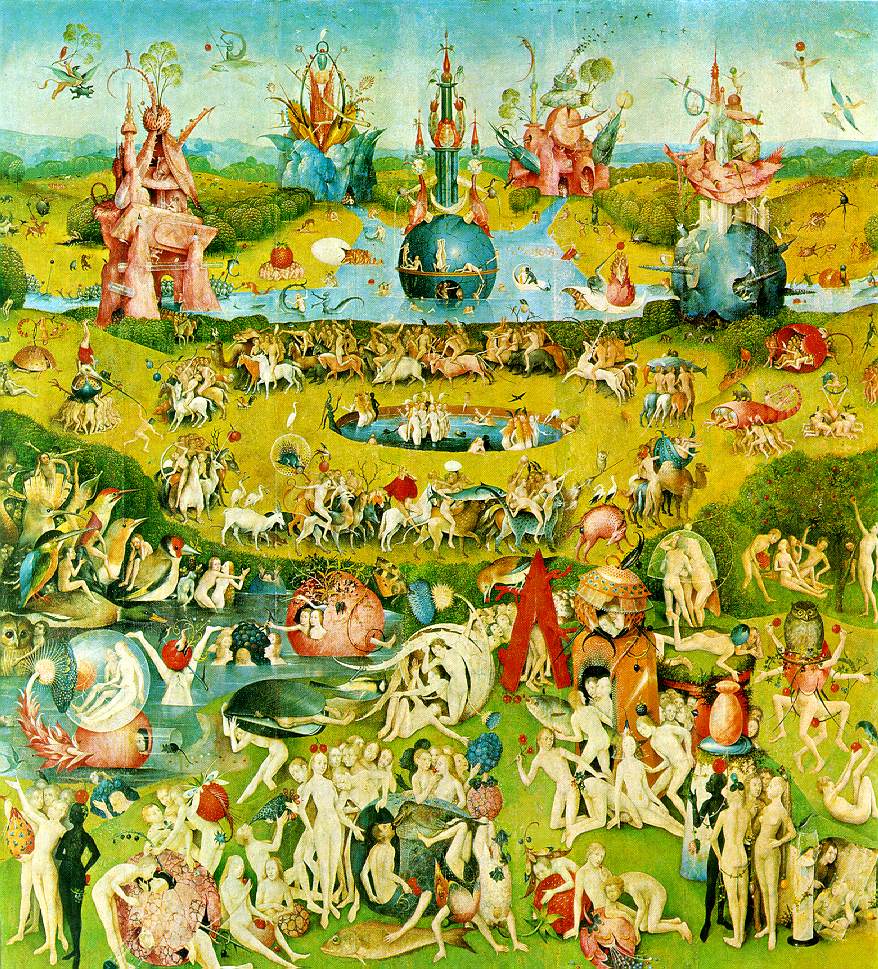
Why should liberals care about these other three moral values? Because there’s a tendency for social order to decay. He shows us the Hieronymus Bosch “Garden of Earthly Delights” – reading from left to right, we see purity, then sexual excess, then hell. This is true artistically, but it’s also true in terms of behavioral economics – research shows that cooperation in economic games decays over time without punishment. We may need authority and purity to maintain social order.
“The Grand Canyon isn’t complicated – it’s just wind and rock. Villages in the Grand Canyon are complicated. This is the wonder of the world.” Civilizations require people to “use every tool in the toolbox.”
“Liberals reject three of these social rules – purity, authority and ingroup identity. They want change and justice even at the cost of social chaos. While conservatives want order, even at cost to those at the bottom.”

He advises us to look for balance, places where Vishu and Shiva work together – the creative and destructive forces. He quotes Sent-ts’an, from 700CE China: “If you want the truth to stand clear before you, never be for or against. The struggle between ‘for’ and ‘against’ is the mind’s worst disease.” He asks us to step out into moral humility “from the moral self-righteousness that is the normal human condition.”
I’m looking forward to Haidt’s book, The Happiness Hypothesis.
Sometimes you’re too polite, Ethan. Haidt is simply full of it. I hope it’s not too far beyond the pale to link to myself, but it takes longer than a one paragraph comment to take him down, so here’s a long-ish blogpost.
Haidt gives us dangerous nonsense, not just silly nonsense. It harks right back to the justifications of oppression, whether it’s castes or women. I’m appalled to hear that he’s being given a platform among the Cool Kidz of TED.
“Why should liberals care about these other three moral values?” What was given in the article in answer to this question was pretty thin. Do we really need sexual “purity” to keep civilization from crumbling? And is that really what killed the Roman empire, or was it despots (Authority) running things into the ground? There was the claim that we need authority to keep things in order. Do you mean like George Bush did? Yegads, I don’t think that the United States or the world could take much more of that kind of order.
There was also no defense in the article for why “ingroup” is such a good thing. Is it really such a good thing to always be dividing people into groups and calling one the winners and all the rest the losers? Is that the way all people think, or just the smaller thinkers? Some of the more modern leadership courses teach the concept that everybody can win. What’s wrong with that?
A reminder, Dean – I’m just blogging these talks. I don’t have any control over what the speakers say – all I’m doing is transcribing, with as much accuracy as I’m able, what Dr. Haidt presented in the session.
In response to dean sellers quote:
“Is it really such a good thing to always be dividing people into groups and calling one the winners and all the rest the losers? Is that the way all people think, or just the smaller thinkers? Some of the more modern leadership courses teach the concept that everybody can win. What’s wrong with that?”
Funny how you separated yourself from from other people, then arbitrarily made yourself the winner and the others who disagree with you the losers (smaller thinkers). If everybody wins then nobody is wrong. Then the original author’s ideas are taken as fact and there should be no argument against them. He isn’t wrong after all. You should do yourself a favor, learn about contradiction before you enter a grown-up conversation.
Um, first off, mortality is metaphysics. secondly i question the so called morals be used here. seriously, this is complete asshattery.
Ummm – preoccupations with authority, ingroup and purity aren’t morals – they are psychological character flaws – Does Haidt not remember a little social experiment called . . The Nazis??? (Wait a minute – how do you pronounce Haidt’s name????)
“research shows that cooperation in economic games decays over time without punishment. ” Hmmm maybe he ought to have a look at some of the results of this social experiment http://www.osearth.com/ – When the world game is weighted with Social Conservatives it often collapse very quickly. Not so when it is weighted with Liberal type folks
What I would really like to see is a study between the CLAIMS people make about their morals and the actions they would actually take given a tough moral situation. For instance, I have a lot of friends I would term ‘liberal’ who would certainly claim to have little or no ingroup bias; but I have a hard time believing if they could save only one person off a sinking ship, they would flip a coin between their mother and a stranger.
As one of the relatively rare folk who regularly travels between groups that are strongly weighted toward more than one of these molar polarities, I find Haidt’s discussion very intriguing. It reminds me a lot of the pioneering work of Psychologist Robert Coles, who spent years and years interviewing children from different social classes. He found, for example, that children of the working classes and poor had (like their parents) a very strong sense of loyalty and care for people in their immediate sphere of relationships. And they thought of moral life in terms of loyalty to those folk. The folk far higher in the social strata thought of morality primarily in terms of abstract principles of social ethics, and tended to spend more time talking about the good of humanity in general. More inclined to think about whether things were “just” in the abstract sense, the higher-ups were less likely to be dedicated to the welfare of particular other people.
Those moral polarities are not precisely the same as the ones noted above, but they do show real differences in moral and ethical formation, within the same society. And I think that Haidt is on the money when he shows a moral polarization between Red and Blue America, since each side is inclined to see the other as essentially immoral or unethical. There are, of course, many “moderates” who try to blend the best of both kids of moral awareness, such as the more “liberal” Evangelical Christians, who combine “social justice” concerns with concern for personal morality in matters like sex.
I do think that it may break down at certain points, however.
Um… Ethan – I don’t think Dean needed that reminder. You’re being oversensitive.
Comments are closed.